
Most fakes give themselves away in five minutes if you know where to look: the code on the inside tag, the crest, the printing and the price. Counterfeit shirts are all over Vinted, eBay, Facebook Marketplace and Instagram, and the good ones look right in a photo. This guide goes through the checks we use, from quickest to most detailed, so you can buy a shirt (new, second-hand or vintage) knowing it’s the real thing.
The quick checklist
If you only have a minute before someone else buys it, check these. One failure isn’t proof, but two or three together usually are.
- Price. A current-season shirt for £20 is not a bargain. It’s a fake.
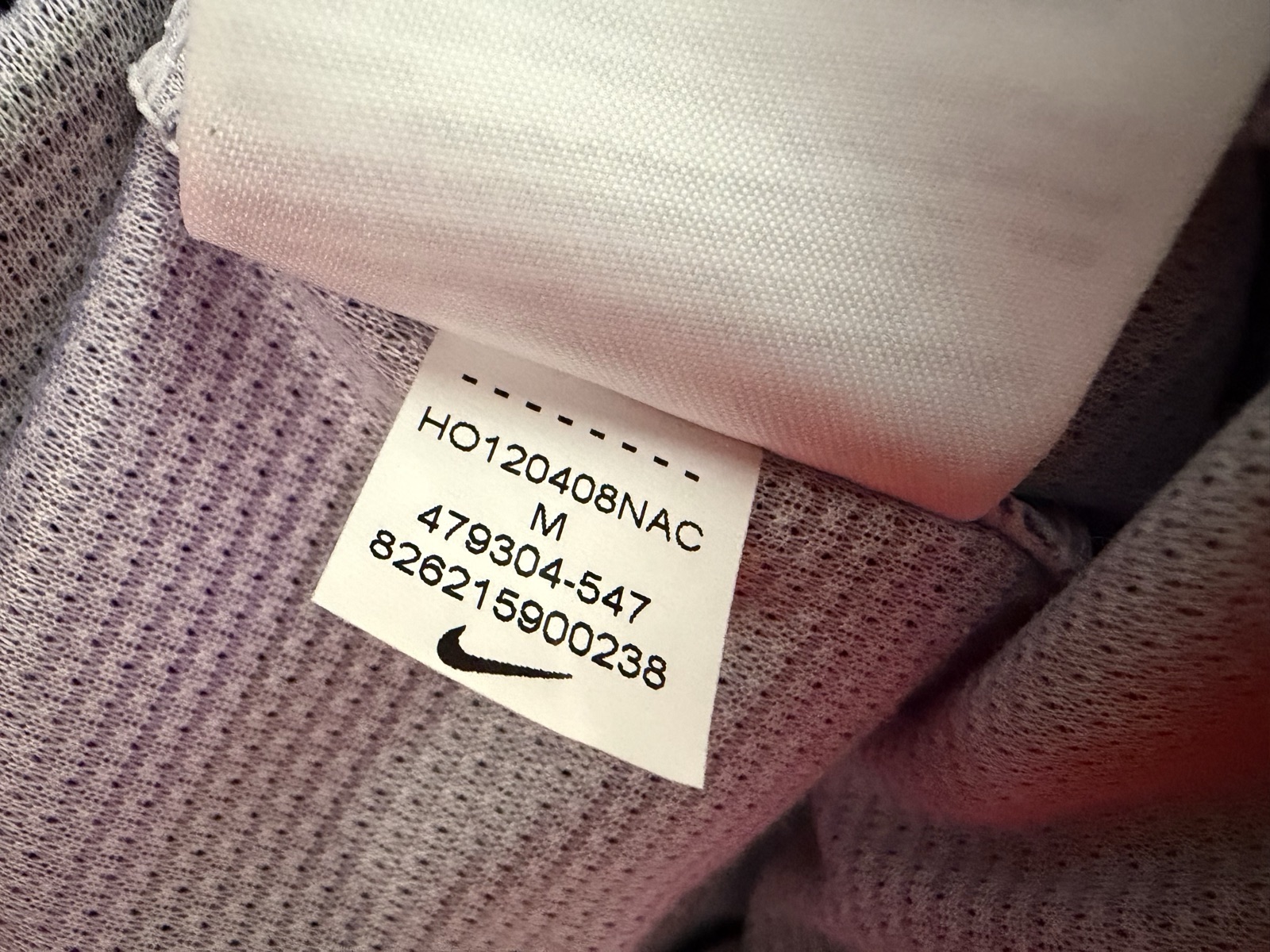
- Product code. Find the small tag inside, search the code on Google and check that the same shirt in the same colour comes up.
- Crest and logos. Look for clean edges, no loose threads between letters, and the right colours.
- Player version at fan price. Fakers love selling “player versions”. A real one costs more than the fan version, not less.
- Names and numbers. The font should match the league and season. The print should have a texture, not a flat, shiny vinyl look.
- Sleeve badges. Real league badges have fine detail and a slightly raised feel. Fakes look printed and blurry.
- Tags. Wash labels should be neatly printed and in several languages, with no spelling mistakes.
- Photos. Stock images only, or the same shirt in every size, means a reseller of fakes.
- Seller. New account, no feedback, shipping from abroad, or asking to pay outside the app: walk away.
Check the product code first
The product code is the single best test, because fakers usually copy one code onto lots of different shirts. Every modern shirt from the big brands has one, on a small tag sewn inside. It’s usually behind the main wash label or down the left-hand side seam.
| Brand | What the code looks like | Where to look |
|---|---|---|
| Nike | Six characters, a dash, then a three-digit colour code (AB1234-567) | Small tag inside, below or behind the wash label |
| adidas | Two letters and four digits (AB1234); some older shirts use one letter and five digits | Small tag near the wash label or inside the neck |
| Puma | Six digits, then a two-digit colour code (123456 01) | Wash label or a small tag beside it |
| Umbro, New Balance, Castore, Hummel, Kappa | Varies by brand and year | Wash label or a small tag beside it |
Type the code into Google Images. You should see exactly the same shirt: same club, same season, same home/away/third, same colour. Warning signs:
- The code brings up a different team, a different season or a pair of trainers.
- The colour code doesn’t match (a home shirt carrying the away shirt’s code).
- The code on the tag doesn’t match the code on the swing tag or the box.
- There’s no code tag at all on a shirt from the last 20 years or so.
One caution: the best fakes now copy the right code. A matching code is a good start, not a guarantee, so keep going through the other checks.
Tags and labels
The inside of a shirt gets less attention from fakers than the outside, so turn it inside out.
- Wash labels. Genuine labels are a stack of thin, silky tags printed in many languages. Print is sharp and evenly spaced. Fakes often have one thick tag, blurry or uneven text, and spelling mistakes.
- Neck print. Most modern shirts have the brand logo and size printed inside the neck, not a sewn-in label. It should be crisp, centred and the right size for the shirt.
- Swing tags. On new shirts, the cardboard tag should carry the same product code as the inside tag, plus a barcode. Flimsy card, wrong fonts or a code that doesn’t match are bad signs.
- Holograms and authenticity tags. Some 1990s and 2000s shirts carry a hologram or a woven authenticity tag. A crisp hologram that changes as you tilt it is a good sign. A flat, shiny sticker isn’t.
- Country of manufacture. Nearly every genuine shirt is made in Asia (Thailand, Indonesia, Vietnam, Cambodia, China and others), so “Made in Thailand” is normal, not a warning sign. It just doesn’t prove anything either way.
Crest, brand logo and sponsor
Get close to the badge. This is where cheap fakes fall down first.
- Embroidery. A real embroidered crest is dense and even, with sharp edges and no gaps showing the shirt through it. Fakes have thin, loose stitching, fuzzy edges and threads running between letters.
- Heat-applied badges. Modern player versions use thin, light badges pressed onto the fabric instead of stitched. They should lie completely flat with crisp detail. Bubbling, peeling corners or a thick plastic feel suggest a fake.
- Colours. Compare against the club shop photos. Fakes are often a shade off: a red that’s slightly orange, a gold that’s yellow, a navy that’s nearly black.
- Position. The crest and brand logo should sit level with each other, at the same height from the collar. A crest that’s lower, bigger or wonky is a common giveaway.
- Sponsor. Check it’s the right sponsor for that season (clubs change them often). The print should be sharp, with no cracking on a new shirt and no rough edges.
- Inside the badge. Turn the shirt inside out. Real embroidery usually has a neat backing; fakes are often messy, with loose threads.
A useful rule: fan versions of recent shirts usually have embroidered or woven crests, and player versions heat-applied ones. A “player version” with a thick embroidered crest deserves a second look.
Fabric and fit: fan or player version
Most brands sell two versions of each shirt. The fan version (Nike call it “Stadium”, adidas “Replica”) is what most people wear. The player version (Nike “Match”, adidas “Authentic”) is the lighter, tighter shirt worn on the pitch, and it costs more.
| Fan version | Player version | |
|---|---|---|
| Fit | Regular, roomy | Slim, close to the body |
| Fabric | Smooth, slightly heavier | Very light, textured, often with small vent holes |
| Nike fabric tag | Dri-FIT | Dri-FIT ADV |
| adidas fabric tag | AEROREADY | HEAT.RDY |
| Crest | Usually embroidered or woven | Usually heat-applied |
| Club shop price | Lower | Higher |
Fakers know people want the player version, so many fakes are sold as one, sometimes described as “Thai quality” or “player issue”. Be wary if:
- A “player version” is cheaper than the club shop’s fan version.
- The fabric tag says Dri-FIT ADV or HEAT.RDY but the shirt feels thick and heavy.
- The pattern in the fabric is printed on rather than woven in. Hold it up to the light: a real textured pattern is part of the knit.
- The seams are uneven or puckered, or the hem is wavy.
Names, numbers and sleeve badges
This is our speciality, and it’s where a lot of otherwise convincing fakes slip up. A genuine shirt can also have fake printing added later, so check the print on its own too.
The font has to match the season. The Premier League has used standard lettering since 1997, and the font has changed several times since. Cup competitions, European games and other leagues use their own. A 2004 shirt with a modern Premier League font, or a league font on a shirt from a cup final, is wrong, whoever made the shirt.
Official lettering has a texture. Real league names and numbers are made by licensed suppliers. Depending on the era they have a soft flocked surface, a fine pattern pressed into them, or a rubbery feel with a slight edge. Fakes are usually flat, shiny vinyl cut from a sheet, with rounded corners where the font should be sharp.
Check the details. Look at the spacing between letters, the curve of the name across the back, and the size of the number against the shoulders. Fakes often space letters unevenly or set the name in a straight line where the real one arches. Many modern numbers also carry a small club or league logo; it should be crisp and complete.
Sleeve badges. Official league patches have very fine detail, raised edges and a slightly soft or rubbery surface. Fake ones look printed and flat, with blurry lettering and a hard plastic shine. Check the badge is right for the season too: the Premier League’s design has changed over the years, and champions’ gold badges only appear on the following season’s shirts.
If you’re not sure about lettering on a shirt you already own, we’re happy to look at photos. You can also browse genuine league lettering by era in our Namesets & Numbers section.
Reading the listing
You can often spot a fake before you’ve seen the shirt in person.
- Price. Second-hand shirts are cheaper, but a current-season shirt in new condition rarely goes for less than half the club shop price. Rare older shirts cost more, not less.
- Photos. Ask for photos of the inside tags, the product code, the back of the crest and the print up close. A genuine seller won’t mind. Stock photos only, or photos that don’t show the tags, are a bad sign.
- Stock. One person selling the same “rare” shirt in every size is a dealer in fakes.
- Words to watch. “Thai quality”, “AAA”, “1:1”, “mirror”, “grade” and “fan made” are all code for a copy.
- The seller. Check their feedback and what else they’re selling. Lots of brand-new shirts from different clubs, all cheap, is a pattern.
- Payment. Always pay through Vinted, eBay or PayPal Goods & Services so you’re covered by their buyer protection. Never pay by bank transfer or PayPal Friends & Family to a stranger.
If you’ve already bought a fake through eBay or Vinted, report it through the platform’s own process. Both treat counterfeits as “not as described”, and you can usually get a refund.
Official retros aren’t fakes, but they aren’t originals either
Licensed remakes of classic shirts are a real and legal product. Score Draw, adidas Originals, Nike, Umbro and the clubs themselves all sell them. They’re a great way to own a classic design, but they’re worth much less than a shirt from the season itself, so make sure you know which you’re buying.
How to tell a remake from an original:
- Modern tags. A remake has current wash labels and a recent product code. An original 1990s shirt has the tags of its time, often with no product code at all.
- Fabric. Many remakes use modern, lighter fabric. Originals from the 1990s often feel heavier and shinier.
- Sponsor. Remakes often leave the sponsor off, especially for alcohol or betting brands. An “original” with no sponsor, from a season that had one, is probably a remake (or a fake).
- Labelling. Some remakes say “retro”, “heritage” or “remake” on the swing tag or the inside label.
The tricky one is a fake of an old shirt, made to look worn. Check the tags match the era, and that the product code (if there is one) brings up the original, not a remake.
How we check our shirts
Every shirt we sell is checked against the points in this guide before it’s listed: the product code, the tags, the crest and the printing. Any names and numbers we add are official league lettering, applied in our own print room. If a shirt ever turns out not to be what we said, you’re covered by our 30-day returns.
Not sure about a shirt you’ve seen somewhere else? Send us photos of the tags, crest and printing through our contact page or on WhatsApp, and we’ll give you our honest opinion.